How to Create a Software Development Plan for Tech Startups
Table Of Content
Published Date :
28 May 2026
Behind every software product there is usually one thing that people do not talk about enough: a clear software development plan.
The code, the design and the technology stack is important. But before any of that a startup needs to know what it is building why it matters, who it is for and how the team will get from idea to launch without wasting time, money or focus.
This is where a software development plan becomes important. When done correctly, it becomes the backbone of the project, enabling development teams to accelerate the development process, overcome challenges, and achieve exceptional results.
For startups planning is not about creating a document that nobody reads after the first meeting. It should be a roadmap that clearly defines the journey from concept to launch. The plan has to be more than just “good.” It must be strategic, detailed, and adaptable enough to address the changing needs of startups. It should help founders, product owners, designers, developers and stakeholders stay aligned when priorities change, budgets get tight or new feedback comes in.
In this guide, we’ll break down the key stages of software project planning, showing you exactly how development teams prepare for success.
Want a Winning Software Development Strategy?
Your idea deserves a roadmap that investors and users trust. Let’s help you structure, plan, and launch with precision tailored for startups.
Why Planning is the Heart of Software Development
Software development is a complex process with multiple moving parts. Requirements change. Users ask for something from what the team expected. Timelines shift. A feature that looked simple in a meeting can turn into weeks of work.
Without a software development plan all of this becomes harder to manage.
Many startups begin with excitement. Move straight into development. That energy is valuable. If it is not supported by structure the project can quickly run into problems: unclear requirements, missed deadlines, budget overruns, technical shortcuts and features that do not match what users actually need.
A proper software development plan helps reduce that risk.
It gives the team a shared direction. It defines what needs to be built what can wait which resources are needed how success will be measured and where the biggest risks might appear.
Importantly it gives startups room to make better decisions. When priorities change the team is not starting from confusion. They can look at the roadmap review the business goal and adjust with clarity.
For a startup that clarity can make a difference.
Key Components of a Software Development Plan
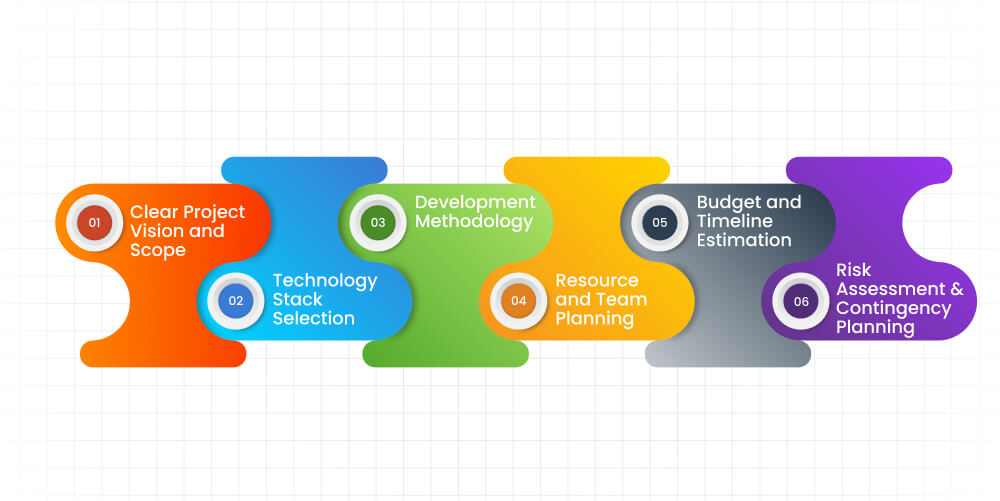
Creating a good plan for software development is not a checklist for a startup. Software development plan means ensuring every detail is accounted for before the first line of code is written. These components form the foundation for a product that’s both scalable and market-ready.
Clear Project Vision and Scope
The first step in software development plan is to define the problem you are solving, target audience, and how the product will address their needs.
- Why would users choose your product over another option?
- What does the first version of the product need to achieve?
These questions sound simple. They often expose gaps in the idea.
A clear vision helps prevent scope creep. It also helps the development team understand the business purpose behind each feature. When developers know why something is being built they can make technical decisions.
For startups this clarity is especially important because time and budget are usually limited.
Technology Stack Selection
Selecting the right technologies affects performance, scalability, maintenance, hiring, integrations and long-term cost. Some startups choose a stack because it is popular. Others choose the option available. Both can create problems later.
The right technology should match the product’s needs and future growth plans. For example a simple MVP may not need a complex architecture but it should still be built in a way that does not block future scaling.
Development Methodology
Startups need flexibility but also discipline. That is why Agile, Lean or a hybrid development approach often works well. These methods allow teams to build in cycles, test assumptions, collect feedback and improve the product without waiting.
The methodology should be decided early because it shapes how the team communicates, plans sprints, reviews progress and handles changes.
A good software building plan should clearly define how work will be organized. Otherwise teams can fall into confusion especially when business and technical priorities start competing.
Resource and Team Planning
Decide whether to build an in-house team or outsource to experts.
Many startups choose custom software development services because they need skills quickly. This is especially useful for products involving AI, IoT, automation, cloud platforms or complex integrations.
The important thing is to define roles. Who owns product decisions? Who manages delivery? Who reviews quality? Who approves changes? A software development plan should answer these questions before development begins.
Budget and Timeline Estimation
Every startup wants delivery but speed without realistic planning usually leads to trouble.
A proper development plan should break down the budget. Timeline across all major stages: discovery, UI/UX design, development, testing, deployment and post-launch support.
It is also smart to keep some buffer for changes. In projects new requirements often appear once users or stakeholders see the product taking shape.
A realistic budget is not about controlling cost. It helps the team make trade-offs.
Risk Assessment and Contingency Planning
Every project plan for software development should include strategies for handling potential delays, technical challenges, and market changes.
At DITS, we go beyond standard planning; we integrate AI software development practices into every project. Our AI-driven approach ensures higher code quality, faster quality assurance, and more precise customization. Whether it’s IoT software development or enterprise-scale platforms, we use AI to enhance efficiency, reduce risks, and deliver smarter solutions.
Looking to Minimize Development Risks?
Startups succeed when planning meets execution. Partner with experts who integrate AI, agile methods, and market research to reduce costly errors.
Step-by-Step Guide to Building a Software Building Plan
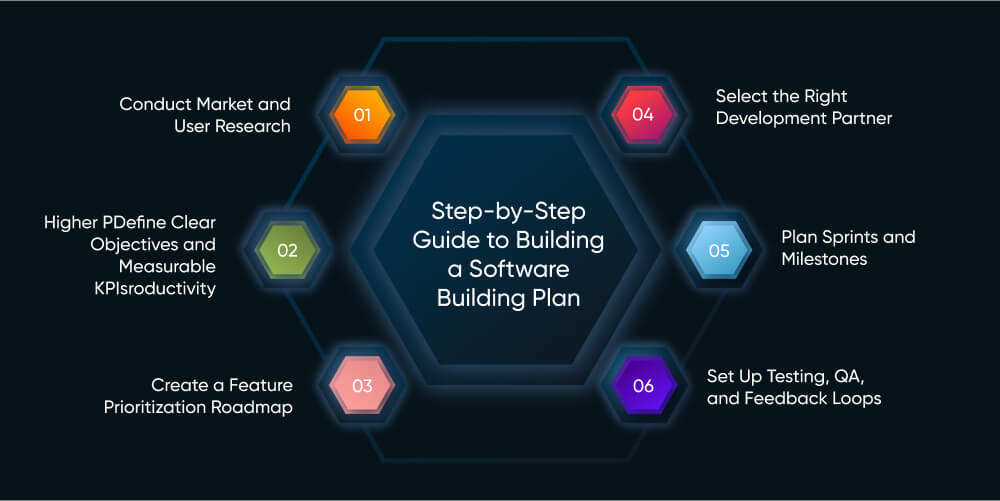
Building a plan for software development doesn’t have to be overwhelming. By breaking it into well-structured steps, your startup can go from idea to launch with greater clarity, efficiency, and reduced risk.
1. Conduct Market and User Research
Start by understanding your target audience’s problems, preferences, and behaviors. Use surveys, competitor analysis, and focus groups to identify opportunities and avoid building features nobody needs. This foundation ensures your product addresses a real demand, making it easier to secure funding and align your software development plan with market realities in Canada.
2. Define Clear Objectives and Measurable KPIs
Set goals that define what success means for your startup—such as user acquisition, revenue targets, or retention rates. Use KPIs to measure progress at every stage. A good software development project plan includes these metrics from the start, helping you stay on track and make data-driven adjustments instead of relying on assumptions.
3. Create a Feature Prioritization Roadmap
Instead of building everything at once, start with a Minimum Viable Product (MVP) that contains only the most essential features. This approach allows you to launch quickly, gather feedback, and make improvements before scaling. A software building plan example should always outline which features to release first and how they align with business goals.
4. Select the Right Development Partner
The right partner will guide you through every stage of your project plan for software development while ensuring technical excellence. Look for a software development company based or with global experience, capable of handling your specific requirements. They should bring proven expertise, industry knowledge, and the ability to adapt to your startup’s evolving needs.
5. Plan Sprints and Milestones
Break your project into smaller, time-bound sprints with clearly defined deliverables. Assign responsibilities, set deadlines, and track progress to ensure transparency. This agile approach allows you to make quick adjustments if priorities change. A strong sprint plan keeps your custom software development organized, predictable, and in sync with your overall business strategy.
6. Set Up Testing, QA, and Feedback Loops
Quality assurance is not a one-time task—it’s continuous. At DITS, we integrate AI into our QA process to detect bugs faster, maintain high code quality, and customize solutions for user needs. Embedding feedback loops at each stage ensures your final product is user-friendly, functional, and ready for market without costly post-launch fixes.
Common Mistakes Startups Make When Planning Software Development
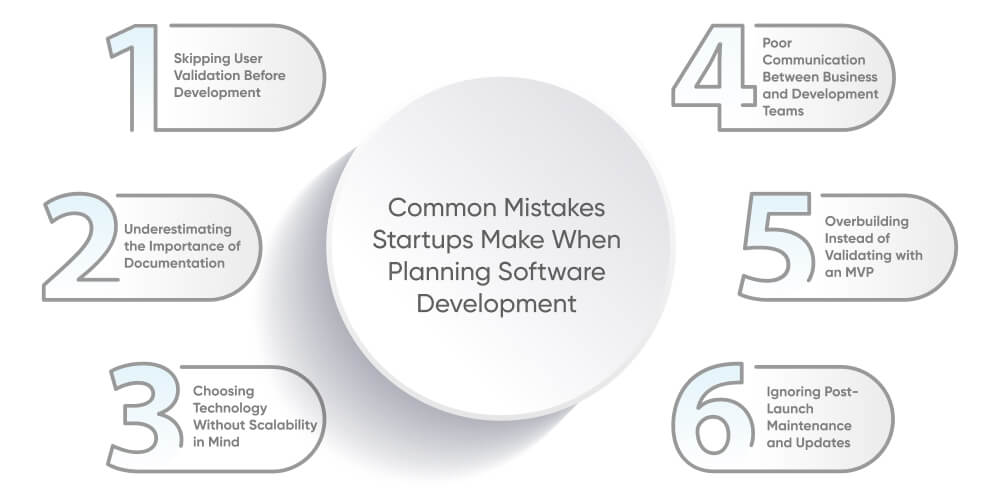
Even with the best intentions, startups often make planning errors that lead to wasted resources, missed deadlines, and unsatisfactory user experience. Avoiding these mistakes can save both time and money while increasing the chances of building a successful application.
1. Skipping User Validation Before Development
Building a product without validating the idea with real users can result in software that fails to solve an actual problem. Before investing heavily in development, consider conducting interviews, running surveys, or creating prototypes to gather valuable feedback. A validated concept aligns your software building plan with real-world demands and reduces the risk of costly rework later.
2. Underestimating the Importance of Documentation
Documentation might seem time-consuming, but it’s essential for project clarity and long-term scalability. Without detailed records of decisions, processes, and technical specifications, teams can lose track of requirements. A well-documented software development project plan ensures that everyone; from developers to stakeholders, stays on the same page throughout the project lifecycle.
3. Choosing Technology Without Scalability in Mind
Some startups select tools and frameworks based solely on cost or popularity, ignoring future growth needs. This short-term thinking often results in expensive migrations later. A carefully chosen stack within the project plan for software development allows your application to handle increased user loads, new features, and integration with emerging technologies without performance issues.
4. Poor Communication Between Business and Development Teams
When founders and developers don’t communicate effectively, misunderstandings can derail progress. Business teams must convey goals, while technical teams should explain limitations and opportunities. Embedding communication checkpoints into the plan ensures smooth collaboration, quicker problem-solving, and fewer changes during development.
5. Overbuilding Instead of Validating with an MVP
Many startups make the mistake of building full-featured products before testing market interest. This often wastes resources on features users don’t value. Following a plan example that prioritizes MVPs lets you launch quickly, validate assumptions, and improve based on feedback, making your product more relevant and cost-efficient in the long run.
6. Ignoring Post-Launch Maintenance and Updates
Some startups treat launch as the finish line, but it’s only the beginning. Without budgeting and planning for updates, bug fixes, and security patches, the software can quickly become outdated. A software development approach includes post-launch strategies, ensuring your product stays competitive and delivers consistent value to your customers over time.
Struggling With Startup Roadblocks?
From scope creep to missed deadlines, poor planning hurts growth. Gain clarity, control, and speed with a software development roadmap built for startups.
How a Professional Development Partner Can Help Startups Win
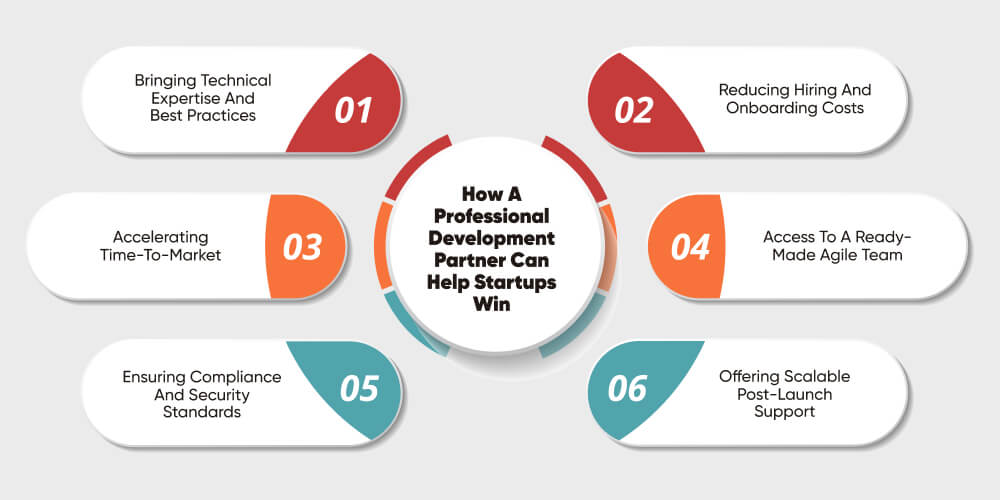
For tech startups, choosing the right development partner is often the difference between struggling through endless iterations and achieving a smooth, timely launch. Partnering with experts who provide end-to-end software development services ensures that your product is built with precision, speed, and scalability in mind.
1. Bringing Technical Expertise and Best Practices
A seasoned partner brings years of experience and proven methodologies to the table, guiding your software development roadmap from concept to deployment. This expertise helps you avoid common pitfalls and adopt industry best practices tailored to your startup’s needs.
2. Reducing Hiring and Onboarding Costs
Instead of building a full in-house team, which can be costly and time-consuming, startups can leverage a partner’s ready-made resources. This reduces HR overhead while ensuring access to specialized skills in areas like IoT and AI development without lengthy recruitment cycles.
3. Accelerating Time-to-Market
An experienced development partner can help your startup move faster by streamlining business workflows, reusing proven code modules, and automating repetitive tasks. At DITS, we integrate AI across all development stages, from maintaining code quality to enabling intelligent customization.
4. Access to a Ready-Made Agile Team
Instead of piecing together freelancers, you get a full team of designers, developers, testers, and project managers who understand the custom software development process. This ensures smoother collaboration and more predictable delivery timelines.
5. Ensuring Compliance and Security Standards
Professional partners build software that meets industry-specific compliance regulations, from data protection to financial transaction security. This is especially crucial for startups that handle sensitive user information.
6. Offering Scalable Post-Launch Support
The right partner doesn’t disappear after launch. They provide continuous updates, feature enhancements, and troubleshooting to keep your product competitive and up-to-date. An experienced software development company ensures your startup can scale without technical setbacks.
How DITS Can Help Startups Build a Plan for Software Development
At DITS, we specialize in creating tailored strategies that help startups turn ideas into successful digital products. Our team works closely with startups' in-house teams to design a development plan that aligns with business goals, budget, and timelines.
We integrate AI into every stage; from requirements gathering to quality assurance; ensuring higher code quality, faster delivery, and more innovative customization. Whether you need custom software development services in Canada expertise or global market experience, we provide end-to-end support covering planning, design, development, and post-launch scaling.
Our agile approach keeps your project adaptable, while our technical proficiency in AI and IoT software development ensures your product is future-ready and competitive in a rapidly changing tech environment.
Is Your Software Plan Investor-Ready?
Investors back startups with direction, clarity, and scalability. Secure confidence by showcasing a robust development plan tailored for growth and risk management.
Conclusion
A well-crafted software building plan is one of the most valuable assets a tech startup can have. It provides clarity, reduces risks, and ensures every step from ideation to launch is aligned with your vision and market demands. By avoiding common mistakes, prioritizing essential features, and partnering with experienced professionals, startups can transform their ideas into scalable, market-ready products.
At DITS, we combine industry expertise with AI-driven innovation to help startups build smarter, faster, and more efficient solutions. Whether you’re aiming for rapid market entry or long-term scalability, the right plan will position your business for sustainable growth and investor confidence. The journey from concept to code is complex, but with the right roadmap, your startup can navigate it successfully.
FAQs
1. What is a software development plan, and why do startups need it?
A software development plan is a roadmap that outlines the scope, timeline, resources, and processes for building a software product. Startups need it to avoid miscommunication, control costs, and ensure development stays aligned with business goals and user needs.
2. How long does it take to create a software development plan for a startup?
The time frame varies depending on project complexity, but most plans can be created in two to four weeks. This includes gathering requirements, defining objectives, selecting technology, and setting up timelines and budgets.
3. Should startups hire in-house developers or outsource software development?
It depends on budget, expertise, and project scope. Many startups choose outsourcing to access experienced teams, speed up delivery, and reduce hiring costs—especially when partnering with a Custom Software Development Company in Canada or a globally experienced provider.
4. What should a good project plan for software development include?
It should cover the project vision, scope, chosen technology stack, development methodology, resource allocation, budget, timeline, risk management, and quality assurance approach. Including a post-launch support strategy is also important for long-term success.
5. How can DITS help startups with their software development needs?
DITS offers end-to-end planning and execution, integrating AI at every stage—from code quality assurance to feature customization. With expertise in AI software development and IoT software development, we create future-ready solutions that are scalable, secure, and market-driven.

Dinesh Thakur
21+ years of IT software development experience in different domains like Business Automation, Healthcare, Retail, Workflow automation, Transportation and logistics, Compliance, Risk Mitigation, POS, etc. Hands-on experience in dealing with overseas clients and providing them with an apt solution to their business needs.
Recent Posts

Explore how AI and IoT enhance parking lot management systems in Canada through automation, real-time tracking, smart pricing, security, and operational efficiency.

Discover the benefits of AI in EHR system for Canadian clinics, including smarter documentation, patient engagement, risk detection, and operational efficiency.
Discover how outsourced software product development services help businesses reduce development costs, access specialized talent, accelerate delivery, and improve scalability.